


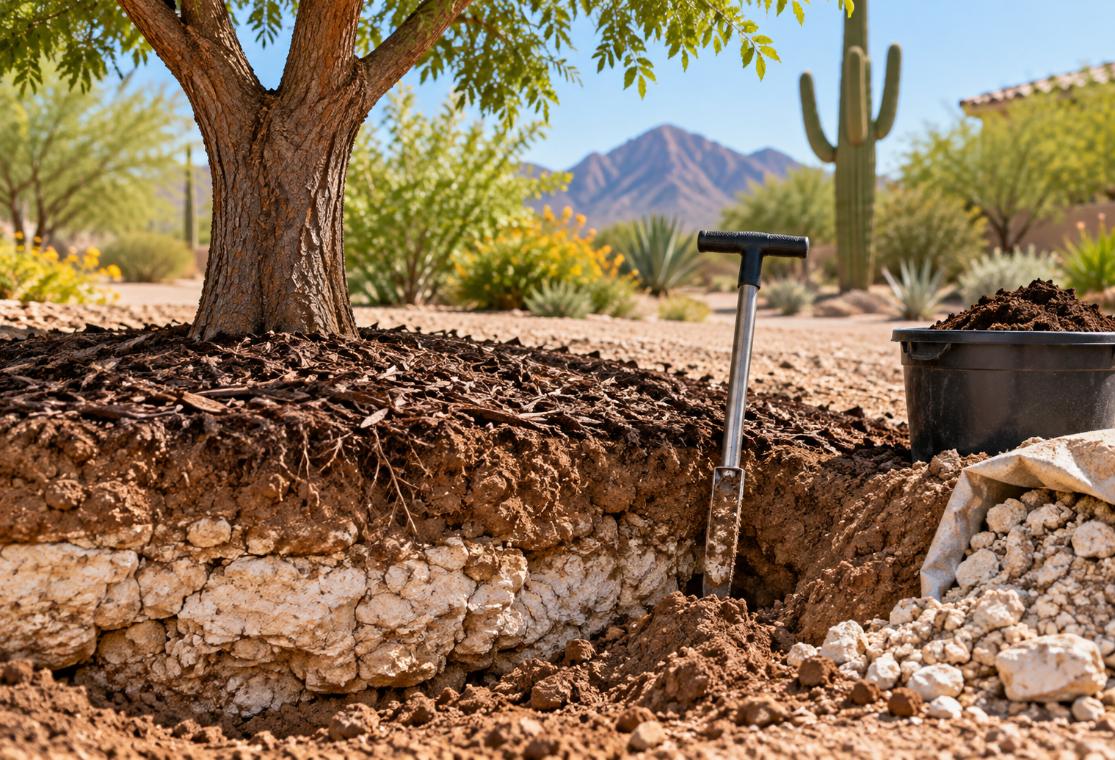
A tree can receive plenty of irrigation and still struggle if the water has nowhere to go. In Phoenix landscapes, a dense layer of caliche below the surface can restrict drainage and root growth, creating a difficult combination of wet soil below and heat stress above.
Quick answer: Caliche is soil cemented by calcium carbonate, and a dense layer can restrict both tree roots and water movement. Before planting or trying to correct a suspected drainage problem, test how quickly water moves through the soil. University of Arizona Cooperative Extension guidance recommends investigating poor drainage and, where practical, penetrating a shallow caliche layer or using a raised planting approach when adequate drainage cannot otherwise be achieved.
What Phoenix property owners should know
-
Caliche can occur as light-colored lumps or as a consolidated layer ranging from relatively loose material to a hard, rock-like barrier.
-
A dense caliche layer can restrict root development, water movement, soil aeration, and the leaching of accumulated salts.
-
University of Arizona Cooperative Extension recommends drainage testing when soil is shallow, compacted, or heavy before installing a tree.
-
Drainage chimneys can sometimes help when a shallow, thin hardpan is responsible for poor drainage, but they should be placed beside rather than directly beneath a tree’s root ball.
-
A tree that looks drought-stressed does not necessarily need more water. Poor drainage can also damage roots and interfere with normal tree function.
Why Does Caliche Matter for Trees in Phoenix?
Caliche matters for trees in Phoenix because a dense layer can restrict both the space available for roots and the movement of irrigation water through the soil. Instead of moving deeper into the soil profile, water may remain above a restrictive layer, leaving roots in poorly aerated soil while limiting their ability to expand.
This is particularly relevant across the Valley, where desert soils, alkaline conditions, intense summer heat, and irrigation management all influence tree performance. Properties in areas such as Arcadia, Ahwatukee, North Phoenix, and neighborhoods near South Mountain can have very different soil profiles even when they are only a short drive apart.
Caliche is not simply another name for hard soil. University of Arizona Cooperative Extension describes it as soil particles cemented together by calcium carbonate. It may occur as scattered concretions or as a solid layer several inches to several feet thick.
Treelation LLC works with trees in the Phoenix area, and we consider below-ground conditions when evaluating why a tree is struggling. Visible symptoms in the canopy can sometimes originate with drainage, rooting space, irrigation, or soil conditions rather than with the leaves and branches themselves.
What Does Local Guidance Say About Caliche and Drainage?
Arizona guidance identifies restricted drainage, limited root development, and reduced nutrient availability as major problems associated with dense caliche. University of Arizona Cooperative Extension notes that impermeable layers can prevent roots from penetrating deeper soil and can allow water to remain above the caliche, reducing root-zone aeration.
The same guidance notes that poor drainage can contribute to salt accumulation because water cannot readily move through the rooting zone. High calcium carbonate levels can also make iron less available to susceptible plants, potentially producing yellowing between the veins of young leaves.
These issues are especially worth considering in Maricopa County landscapes where trees depend heavily on managed irrigation through long periods of hot, dry weather.
How Can You Test Tree Drainage in Phoenix Soil?
You can test tree drainage by observing how long water remains in a test hole, with standing water after 24 hours indicating poor drainage under current University of Arizona planting guidance. For shallow, compacted, or heavy soil, Cooperative Extension recommends digging approximately one foot deep in dry soil and filling the hole completely with water twice during the day.
If water remains 24 hours after the second filling, drainage is considered poor. This test can be performed before planting and can help reveal whether a site needs additional investigation.
Older University of Arizona caliche-specific guidance also describes partially filling a planting hole and looking for the water level to fall at least four inches in four hours.
The important point is not to assume that a hard surface automatically tells you what is happening deeper underground. Compaction, clay, construction disturbance, and caliche can all affect infiltration.
What Warning Signs Can Point to Poor Tree Drainage?
Warning signs of poor tree drainage include persistently wet soil, weak growth, canopy decline, and symptoms that continue even though the tree is receiving adequate irrigation. No single symptom proves that caliche is responsible, so the soil, irrigation pattern, planting depth, and tree condition should be considered together.
Watch for:
-
Water remaining in a basin or planting area much longer than expected.
-
Soil that stays wet well after irrigation.
-
New growth that appears weak despite regular watering.
-
Yellowing of younger leaves, particularly between green veins.
-
A tree that declines after irrigation frequency is increased.
-
Limited establishment or growth after planting.
-
Roots concentrated unusually close to the surface.
-
Instability that may be associated with a restricted root system.
In Phoenix, these symptoms can overlap with heat stress and irrigation problems. Increasing watering without checking drainage can therefore make some root-zone problems worse.
When Should You Call a Tree Professional?
Call a tree professional when drainage remains poor, an established tree is declining without an obvious cause, or correcting the soil would require excavation around significant roots. A homeowner can perform a basic drainage test, check irrigation emitters, and observe how long the soil stays wet, but excavation around established roots deserves more caution.
This is particularly important with mature trees. Cutting roots to reach or break a suspected caliche layer can create a different problem while trying to solve the first one.
Professional evaluation can help distinguish among drainage restrictions, irrigation issues, planting depth, soil compaction, root problems, and unrelated tree disorders before corrective work begins.
What Commonly Causes Poor Tree Drainage in Phoenix?
Poor tree drainage in Phoenix commonly results from restrictive soil layers, compaction, soil texture, or planting and irrigation practices rather than from caliche alone. Identifying the actual restriction is important because the appropriate solution changes with the cause.
1. Dense caliche layers: A consolidated calcium carbonate layer can restrict water and root penetration.
2. Compacted urban soil: Construction activity and repeated traffic can reduce pore space, limiting water infiltration and air exchange. University of Arizona Cooperative Extension notes that urban soils are commonly compacted.
3. Heavy soil: Fine-textured soil can drain slowly, particularly where another restrictive layer lies beneath it.
4. Planting too deeply: Current University of Arizona guidance recommends planting holes no deeper than the root ball, with the top of the root ball level with or slightly above finished grade.
5. Irrigation that exceeds the site’s drainage capacity: More water is not automatically better. If soil remains saturated too long, roots can be damaged.
How Can Caliche-Related Drainage Be Improved?
Caliche-related drainage can sometimes be improved by penetrating a shallow restrictive layer, creating properly positioned drainage chimneys, or increasing usable rooting depth with a raised planting area. The right approach depends on the thickness and location of the caliche and whether the tree is already established.
University of Arizona Cooperative Extension says chimney holes may help where a shallow, thin hardpan causes poor drainage. These holes should be made beside, not beneath, the root ball and filled with the same soil used in the planting area rather than gravel. Very thick caliche layers can make this approach impractical.
Where adequate drainage cannot be achieved by penetrating the restrictive layer, raised planting can provide additional rooting depth. Soil added for this purpose should have a texture similar to the native soil.
For new trees, testing drainage before planting is far easier than trying to correct a severe underground restriction after the tree becomes established.
What Results Should You Expect After Improving Drainage?
Improving drainage should provide roots with a better balance of water and oxygen, but it will not produce an immediate or guaranteed canopy recovery. The result depends on the tree species, existing root damage, irrigation management, planting depth, soil conditions, and how long the problem has been present.
A newly planted tree benefits from identifying the restriction before substantial roots develop. An established tree may require a more conservative approach because excavation can disturb or sever important roots.
After corrective work, irrigation should be reassessed rather than simply continued on the old schedule.
What Mistakes Should Phoenix Property Owners Avoid?
The biggest drainage mistakes are assuming every hard soil layer is caliche, adding more irrigation to a poorly drained root zone, and excavating aggressively around established roots. A drainage test and site evaluation provide better information before corrective work begins.
Mistake: Adding gravel to a drainage chimney.
Consequence: It does not follow current University of Arizona planting guidance.
Better approach: Fill chimney holes with the same soil used in the planting area.
Mistake: Digging a narrow, extra-deep planting hole.
Consequence: The tree may sit too deeply while roots remain poorly positioned.
Better approach: Follow shallow, wide planting principles and address the actual restrictive layer.
Mistake: Assuming compost in the planting hole will fix drainage.
Consequence: It does not remove a physical caliche barrier.
Better approach: Current University of Arizona guidance recommends unamended native soil for tree and shrub backfill.
Mistake: Breaking soil around a mature tree without considering roots.
Consequence: Important roots can be damaged.
Better approach: Have the root zone evaluated before significant excavation.
What Is a Common Phoenix Caliche Scenario?
A common Phoenix scenario is a young tree that receives regular irrigation but establishes slowly because water movement below the planting area is restricted. The homeowner may respond by watering more often, yet the underlying drainage problem remains.
A drainage test reveals that water persists in the soil much longer than expected. Further investigation may identify a restrictive layer beneath the rooting area.
The solution is not automatically more irrigation or fertilizer. The site first needs to be evaluated to determine what is restricting drainage and whether that restriction can safely be corrected.
This is a representative local scenario, not a Treelation LLC case study.
What Tree Services Can Help With Drainage-Related Problems?
Tree assessment can help determine whether poor drainage is contributing to decline and whether the symptoms point to soil conditions, irrigation, planting problems, or another cause. For an established tree, the goal should be to understand the problem before disturbing the root system.
We can evaluate the tree and surrounding site and discuss appropriate next steps based on observable conditions.
Should You Test Drainage Yourself or Call a Professional?
A basic drainage test is reasonable for homeowners, while excavation around established trees and diagnosis of continuing decline are better suited to professional evaluation. The distinction largely comes down to the potential for root damage and the complexity of the symptoms.
Before planting, homeowners can test drainage and identify obvious hard layers. For an existing mature tree, digging through the root zone simply to search for caliche can damage roots. If a valuable tree is already showing canopy decline, diagnosis should generally come before major soil disturbance.
Where Do We Address Tree Concerns in the Phoenix Area?
Phoenix and surrounding Valley communities can experience similar desert soil challenges, although conditions vary substantially from one property to another. Caliche depth and soil compaction can differ even within the same neighborhood.
We encourage property owners throughout Phoenix and nearby Maricopa County communities to evaluate actual site conditions rather than assume that every hard or poorly draining soil has the same cause.
What Can Happen If Poor Drainage Is Ignored?
Ignoring persistent poor drainage can leave tree roots with inadequate aeration, restrict root development, encourage salt accumulation, and contribute to continuing tree stress. Dense caliche can also limit the volume of soil available for roots, making a tree more dependent on the conditions in a relatively shallow rooting zone.
Waiting can also make correction more complicated as a young tree becomes larger and develops more roots in the affected area.
FAQ About Caliche and Tree Drainage in Phoenix
Is caliche common in Phoenix soil?
Caliche can occur in Phoenix-area desert soils, but it should not be assumed to exist at every property or at the same depth. University of Arizona Cooperative Extension describes caliche as a common issue in southern Arizona soils, with layers ranging from loose deposits to highly consolidated material. Site-specific investigation is the safest approach.
How do I know if I have caliche or simply hard soil?
You generally need to examine the soil profile because hard soil alone does not prove that caliche is present. Compaction, clay, construction disturbance, and calcium carbonate deposits can all affect Phoenix soil. Caliche commonly appears as light-colored concretions or a cemented, sometimes rock-like layer.
How long should a drainage test take in Phoenix?
Current University of Arizona tree-planting guidance considers drainage poor when water remains 24 hours after the second filling of a roughly one-foot-deep test hole. Testing is particularly appropriate where Phoenix soil is shallow, compacted, or heavy. Older caliche-specific guidance also provides a four-inch-in-four-hours benchmark.
Can I break through caliche before planting a tree?
Yes, penetrating a shallow restrictive caliche layer may improve drainage when it can be done practically before planting. University of Arizona guidance describes drainage chimneys through shallow hardpan, positioned beside rather than directly beneath the root ball. Thick caliche can make this technique impractical.
Should I put gravel beneath a tree planted in Phoenix?
No, gravel is not recommended as the fill for drainage chimneys in current University of Arizona tree-planting guidance. The guidance recommends filling chimney holes with the same soil used in the planting hole. Correcting the underlying drainage restriction is more important than creating a gravel-filled pocket beneath the tree.
Can caliche make tree leaves turn yellow?
Yes, caliche can contribute to iron deficiency symptoms because calcium carbonate and high soil pH can reduce iron availability. Susceptible trees may develop pale or yellow tissue between green veins on younger leaves. However, yellow foliage has multiple possible causes, so symptoms alone do not confirm a caliche problem.
Does a Phoenix tree with poor drainage need less water?
A tree with poor drainage needs irrigation matched to its actual root-zone conditions rather than automatically receiving more or less water. Soil type, tree species, season, root depth, and irrigation coverage all matter. If soil stays saturated for long periods, determine why before simply increasing irrigation frequency.
Can I fix caliche around a mature tree myself?
Minor observation and drainage testing may be appropriate, but substantial excavation around a mature Phoenix tree can damage important roots. Because roots can extend well beyond the trunk and canopy area, correcting suspected caliche around an established tree requires more care than preparing an empty planting site.
Protect the Root Zone Before Phoenix Heat Magnifies the Problem
Healthy desert trees depend on what happens below ground as much as what is visible in the canopy. Testing drainage, identifying the actual soil restriction, and correcting irrigation or planting problems appropriately can give roots a better environment without unnecessary excavation.
Give Your Phoenix Trees a Better Foundation
We can help evaluate tree stress and the surrounding site so you can make informed decisions about drainage, irrigation, and tree care.